


At What Age Should Your Child Start Learning a Foreign Language?

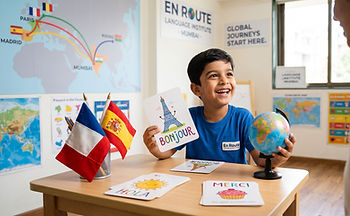
It is the most common question we get here at En Route. Parents know that speaking a foreign language is a massive advantage—it boosts brainpower, looks fantastic on college applications, and opens up global career paths. But figuring out when to start can feel like a guessing game.
So, what is the magical "perfect" age to introduce your child to French or Spanish?
Let's break it down.
The Short Answer: Earlier is Better (But It's Never Too Late)
You've probably heard that kids' brains are like sponges. Scientifically speaking, this is absolutely true. Up until puberty, the human brain is uniquely wired to acquire language naturally. They don't just "learn" a language; they absorb it.
But that doesn't mean a 12-year-old has missed their chance. Kids learn differently depending on their age, and each stage has its own unique superpower.
Ages 4 to 7: The "Little Sponges" Phase
At this age, kids aren't intimidated by new sounds. While adults feel silly trying to roll their 'R's in Spanish or nail the guttural 'R' in French, young kids just think it's a fun game.
Their superpower: Flawless pronunciation. Kids in this age bracket are much more likely to develop a native-like accent.
How they learn: Through play, songs, colors, and mimicking. We don't sit a 5-year-old down and teach them verb conjugations! It is all about joyful immersion.
Ages 8 to 12: The "Connecting the Dots" Phase
This is a fantastic time to start. Kids in this group still have high brain plasticity, but they also have a secret weapon: they already understand how their native language works.
Their superpower: Cognitive strategy. They can start understanding the "rules" of a language.
How they learn: They can handle a mix of fun, interactive activities and basic grammar. They start noticing patterns, like how Spanish nouns have genders, and they love the feeling of "cracking the code."
Ages 13+: The "Goal-Oriented" Phase
Did you wait until middle or high school? Don't panic. Teenagers are highly effective learners. What they lose in natural "sponge" ability, they make up for with sheer study skills and motivation.
Their superpower: Context and focus. Teens can learn a massive amount of vocabulary quickly.
How they learn: They are motivated by real-world goals—like passing the DELF/DELE exams, preparing for university abroad, or actually wanting to understand their favorite Spanish Netflix show.
Beyond the Report Card: The Hidden Benefits
Yes, knowing French or Spanish will eventually look great on their CV. But learning a language does something even cooler in the present moment: it changes how your child's brain works.
Bilingual (or multilingual) kids have been shown to have better problem-solving skills, higher creativity, and improved focus. They are constantly juggling two sets of rules in their heads, which exercises their brain's "executive function." Plus, it builds incredible cultural empathy. They learn early on that their way of looking at the world isn't the only way.
So, When Should You Start?
Start when it makes sense for your child, but if you have the option to start now, take it. The longer they are exposed to a language, the more natural it becomes.
Here at En Route, our Kids Courses are specifically designed to match how young minds actually work. We ditch the boring textbooks and focus on making French and Spanish vibrant, interactive, and genuinely fun. We want them to fall in love with the language first—the grammar rules will naturally follow.


Comments